

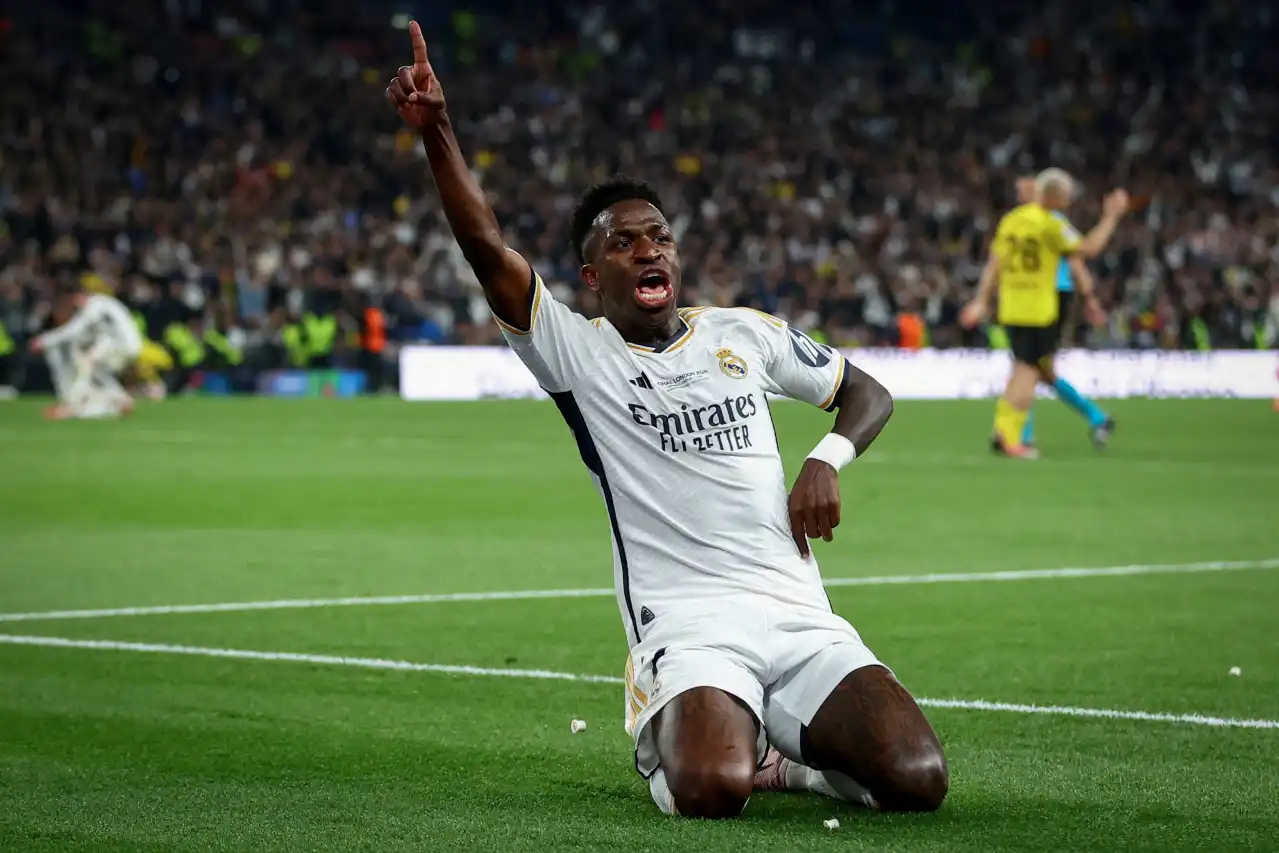
On a Champions League night in Lisbon on February 17, 2026, Real Madrid’s Brazilian forward Vinícius Júnior scored one of the most spectacular goals of his career. With technique and precision he bent the ball into the top corner, giving his team a 1-0 win over Benfica in their first leg Champions League knockout tie at the Estádio da Luz. What should have been a night of celebration became something else entirely. An incident unfolded in real time that caught the attention of fans, media, players, organisations, and entire nations because of a shocking allegation: Vinícius had been racially abused by a player from Benfica during the match, and the implications were far greater than the scoreline.
Right after his goal, Vinícius celebrated with his trademark energy, dancing near the corner flag and close to Benfica supporters. Moments later, some players from the Portuguese club confronted him. A mêlée of emotions, frustrations, and words followed. Vinícius suddenly approached the referee, François Letexier, claiming he had been called a racist slur. The French official stopped the match and activated UEFA’s anti-racism protocol by crossing his arms in an X, a gesture indicating alleged discriminatory language had been used. For ten long minutes players from both sides stood around the pitch as the world watched and waited.
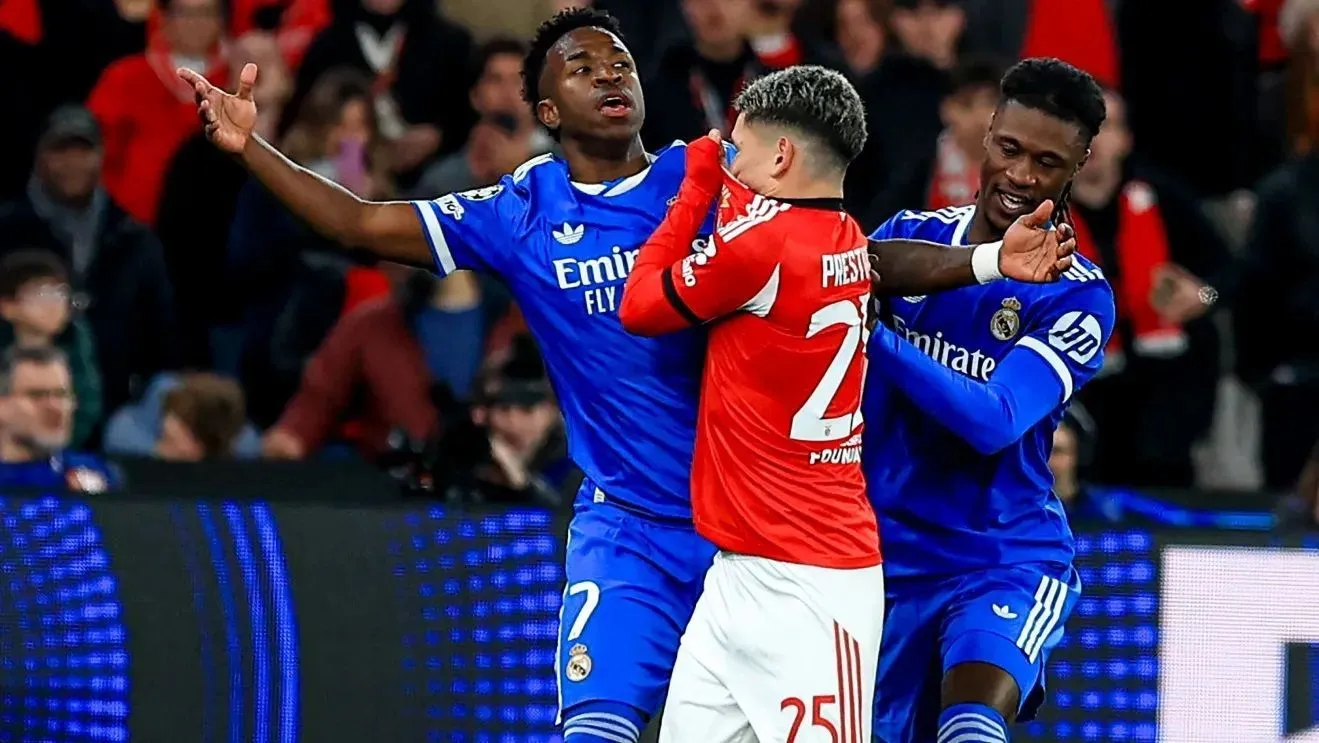
The heart of the allegation was aimed at Gianluca Prestianni, an Argentine winger from Benfica. Vinícius claimed that Prestianni directed at him the Spanish word “mono,” meaning monkey, a word with an ugly history in racist insults directed at Black people. In the broadcast footage, Prestianni briefly has his shirt over his mouth. When he pulled the shirt aside, he appeared to say something in a low voice. Vinícius reacted, visibly upset, and alerted the referee.
After the Moroccan referee stopped the match under the anti-racism directive, players gathered, coaches spoke, and tension hung thick in the air. Vinícius’s teammates rushed toward him as he sat on the bench during the break in play. Some even considered leaving the pitch entirely in protest, an unprecedented gesture in a Champions League tie of this caliber. In the end, the game resumed without any immediate punishment for Prestianni, and Real Madrid finished the match with the winning score intact.
But the incident did not end with the final whistle. The following day UEFA opened a formal investigation to review what had happened. Videos, audio, referee reports, and statements from both clubs were submitted as evidence as part of this disciplinary review. Under UEFA guidelines, a player found guilty of racial insults could face a ban of up to ten matches or even more, depending on severity.
In his own words, Vinícius reacted strongly on social media. He said that racists are “above all cowards,” and highlighted the pathetic need for abusers to cover their faces while they hurl slurs. He criticised the so-called anti-racism protocol, saying it was not effective enough and that the authorities still fail to take decisive action. His post resonated with millions. Many commentators said his reaction spoke volumes about frustration that black players feel when the structures around them do not protect them.
Benfica swiftly backed its player, Prestianni, releasing a statement denying that any racist insult was hurled. Prestianni claimed the whole situation was a misunderstanding. He said he never made a racist remark at any time and that language could have been misinterpreted in the heat of the moment. He expressed regret over threats he received from Real Madrid players and fans in the aftermath. Others in his club echoed sentiments that there had been no racist intention, and that the images on television were inconclusive because of distance and audio uncertainty.
Benfica’s official social media account published a message asserting that Real Madrid players could not have heard anything due to the physical distance on the pitch and that video evidence was insufficient to prove the claim. This response inflamed tensions further as defenders of Vinícius saw it as an attempt to minimise or dismiss a serious allegation instead of confronting it directly.
Complicating matters further, some reporting suggested Prestianni told investigators he had used a different slur altogether, not racist in nature but homophobic, though this version emerged in isolated articles and remains contested. Regardless of motive or intent, the fact that any form of discriminatory language might be used in a professional football game raised serious questions about culture and conduct.
Teammates and fellow professionals expressed unwavering support for Vinícius. Kylian Mbappé, his Real Madrid teammate, was vocal in the immediate aftermath. He was seen defending Vinícius on the pitch and later backed him publicly, encouraging him not to back down from confronting discrimination. Other players like Trent Alexander-Arnold weighed in from outside, condemning the incident as a disgrace to the sport.
Real Madrid coach Álvaro Arbeloa said the club would have left the pitch entirely if Vinícius had wanted that. He emphasized that racism has no place on a football field or outside it. Their entire team stood firmly behind the Brazilian, reinforcing unity against discriminatory behaviour.
From outside Spain and Portugal, international football figures also spoke up. Pep Guardiola, one of the most respected coaches in the world, used the incident to highlight wider societal failures, saying that racism exists everywhere and must be fought through education as well as sportsmanship. He emphasised that teachers and mentors have a role in shaping attitudes long before football players ever set foot on a pitch.
Vincent Kompany, manager of Bayern Munich, criticised José Mourinho, Benfica’s coach, for his postmatch comments that appeared to focus on Vinícius’s behaviour rather than addressing racism head-on. Kompany said it was a huge mistake to deflect from serious allegations by shifting conversation toward context instead of condemning racism unequivocally.
Other voices in the sporting community called for even stronger actions. Former players, pundits, and commentators suggested that cases like these should lead not just to bans from matches but to legal consequences outside sport, similar to how societies treat hate speech and harassment. These opinions ignited debates about jurisdiction, laws, and responsibilities in sporting contexts.
While this incident was shocking, it did not exist in a vacuum. Vinícius had previously endured racist abuse in various leagues, notably in Spain where fans have been recorded making monkey sounds at him during games, and where he has publicly criticised La Liga for not doing enough to curb discrimination. These patterns underscore a recurring struggle faced by black players across Europe and worldwide.
Such experiences have exacted a toll on the Brazilian emotionally and professionally. He represents not only a club but a community of people who experience discrimination daily, and his outspokenness on these issues has made him a symbol for change and accountability. For some, Vinícius pushing back against racism is empowering. For others, it is controversial and polarising in a sport that often prefers to avoid socio-political confrontation.
Institutions like the CBF (Brazilian Football Confederation), FIFA, UEFA, and anti-racism bodies such as Kick It Out have all been drawn into the conversation. The CBF formally called on FIFA and UEFA to apply punishments that reflect the severity of racial insults, highlighting that statutes require football to be free of discrimination and demanding effective measures to stop offenders.
The Guardian and other outlets connected this episode with a broader discussion about how racism remains embedded not just in stadium culture but also in administrative responses and leadership attitudes across clubs and governing bodies.
This incident involving Vinícius Júnior and the accused racist remarks by a Benfica player is not simply an isolated match controversy or a momentary flare-up between rival clubs. It has sparked debate across media, fan communities, institutions, and social movements. It has reminded the world that, despite decades of campaigning against discrimination, racism still affects even the highest levels of sport. It has also highlighted how responses from clubs and authorities can either support victims and uphold dignity or deepen wounds and create further division.
For Vinícius himself, this is part of a journey he has been on for years. As a leading figure in modern football, what he endures both on and off the pitch resonates well beyond a sporting contest. Whether UEFA’s investigation results in significant punishment for Prestianni or not, the conversation sparked by this incident will continue.
0 Comments