
On April 28, 2026, at the Parc des Princes, something happened that did not feel like a normal football match. It felt too fast, too precise, too chaotic, and at the same time too controlled to be explained in simple tactical terms. When Paris Saint-Germain defeated Bayern Munich by 5 goals to 4 in the UEFA Champions League semi final first leg, the scoreline alone already told a story, but it still did not capture what actually unfolded across those ninety minutes.
Nine goals in a Champions League semi final should suggest defensive mistakes, randomness, or lack of structure, yet this game felt like the opposite. It was organized chaos, a high level exhibition of attacking football where both teams seemed fully aware of the risks they were taking and decided to embrace them anyway. Observers and analysts immediately began placing it among the greatest matches ever played, not just because of the number of goals, but because of the quality behind almost every single action.
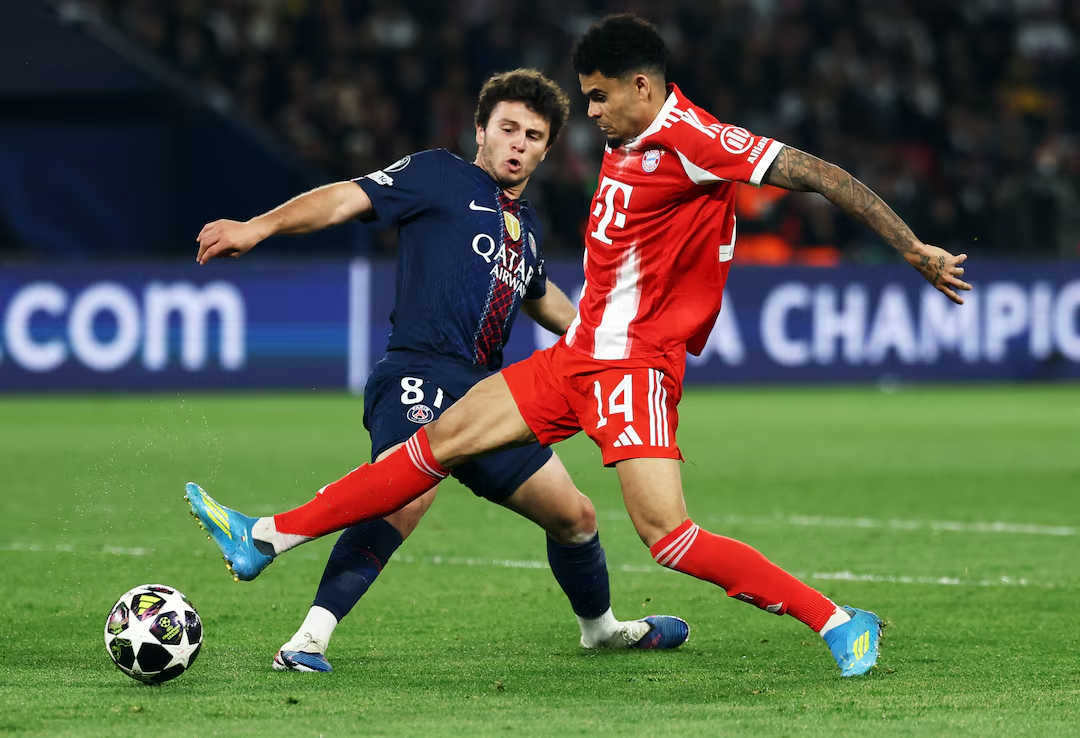
The semi final brought together two of the most explosive attacking sides in European football. Paris Saint-Germain entered as defending champions, carrying the weight of expectation and the confidence of a team that had already proven it could win on the biggest stage. Bayern Munich, on the other hand, came in with a relentless offensive identity, scoring at a rate that few teams in modern Champions League history could match.
Both teams had already crossed the 40 goal mark in the competition, something that had never happened simultaneously before at this stage.
This was not supposed to be cautious. It was supposed to be intense. But nobody expected it to become something that would be described as one of the greatest spectacles in football history.
The match began with a sense of tension rather than chaos. For the first fifteen minutes, both teams pressed aggressively but still maintained some structure. Bayern looked slightly sharper in possession, moving the ball with clarity and forcing PSG to react.
The breakthrough came in the 17th minute when Bayern were awarded a penalty. Harry Kane stepped up and converted, continuing his incredible scoring run and giving the German side the early advantage.
At that point, the game still felt predictable. Bayern had control, PSG needed to respond, and the match seemed to be following a familiar Champions League script.
That illusion did not last long.
The equalizer came quickly through Khvicha Kvaratskhelia, whose ability to create space and finish under pressure has become one of the defining traits of his game. His goal changed the rhythm instantly.
From that moment on, the match stopped being structured in the traditional sense. Instead, it became a sequence of rapid transitions, individual brilliance, and constant attacking intent from both sides.
Shortly after, João Neves gave PSG the lead with a header, capitalizing on a set piece situation that Bayern failed to deal with properly.
Bayern responded again, this time through Michael Olise, who brought the score back to 2-2. At this point, it became clear that neither team was going to slow down.
As the first half approached its end, the intensity did not drop. If anything, it increased.
PSG were awarded a penalty in stoppage time, and Ousmane Dembélé converted it, giving PSG a 3-2 lead going into halftime.
Five goals in one half of a Champions League semi final is already extraordinary. But what made it even more remarkable was how natural it felt within the flow of the game. There was no sense of chaos in the negative sense. It was controlled aggression, with both teams fully committed to attacking football.
If the first half was intense, the second half was overwhelming.
Within a span of just a few minutes, PSG extended their lead from 3-2 to 5-2. Khvicha Kvaratskhelia scored his second, followed almost immediately by another goal from Ousmane Dembélé.
At 5-2, the match seemed over. In most high level games, a three goal lead at this stage would effectively end the contest. The logical expectation was that PSG would manage the game, slow the tempo, and protect their advantage.
That did not happen. Instead of collapsing, Bayern reacted immediately.
Dayot Upamecano scored to make it 5-3, and just minutes later Luis Díaz added another, bringing the score to 5-4.
What made this comeback attempt so compelling was the speed at which it happened. In a matter of minutes, the entire narrative of the match changed again. PSG went from being in complete control to being under pressure.
The final stages of the match were played at an intensity that is rarely seen even in elite football. Both teams continued to attack, even though the scoreline suggested caution would be the smarter approach.
To understand why this match became so extreme, it is necessary to look at the tactical choices made by both teams.
Both sides prioritized attacking width and vertical transitions. Bayern relied heavily on quick ball progression through midfield and aggressive runs from wide players, while PSG focused on exploiting spaces behind Bayern’s defensive line.
Neither team consistently dropped into a low defensive block. Instead, both maintained relatively high defensive lines, which created large spaces for attackers to exploit.
This approach made the game incredibly open. Every turnover of possession had the potential to become a goal scoring opportunity.
Several players delivered performances that elevated the match beyond a typical high scoring game.
Ousmane Dembélé was at the center of everything for PSG, scoring twice and influencing multiple attacking sequences. His ability to operate between lines and create chaos in Bayern’s defense was one of the key reasons PSG were able to score five goals.
Khvicha Kvaratskhelia also played a crucial role, combining technical skill with direct attacking intent.
For Bayern, Harry Kane provided leadership and composure, while players like Michael Olise and Luis Díaz added creativity and pace.
This was not a game where one player dominated. It was a collective exhibition of attacking talent.
The match set several records and milestones.
It became the highest scoring semi final in Champions League history, with nine total goals. It was also the first time both teams scored four or more goals in a semi final, highlighting just how unusual the game was.
Beyond statistics, it also entered conversations as one of the greatest matches ever played, with pundits and analysts comparing it to iconic finals and historic encounters.
There have been many high scoring games in football history, but this one felt different for several reasons.
First, the quality of finishing was exceptionally high. PSG scored with all five of their shots on target, which is extremely rare at this level.
Second, the game maintained its intensity from start to finish. There were no slow periods, no moments where the tempo dropped significantly.
Third, both teams played with a level of confidence and attacking intent that is rarely seen in matches of this importance.
Beyond tactics and technique, this match was also a psychological contest.
When PSG went 5-2 up, the expectation was that Bayern would lose belief. Instead, they responded immediately, showing resilience and refusing to accept the situation.
At the same time, PSG had to deal with the pressure of conceding two quick goals and the possibility of losing control of the game. This constant shift in psychological momentum added another layer to the match.
The 5-4 scoreline left the tie completely open.
Bayern, despite losing, still had a realistic chance of advancing, especially with the second leg being played at home. PSG, on the other hand, had the advantage but knew that a one goal lead was far from secure.
This set up a second leg that promised to be just as intense as the first.



Leave a Reply