
For a club that has built its entire identity around winning, lifting trophies, and dominating the biggest stages in football, the idea of Real Madrid going two consecutive seasons without major silverware feels almost surreal. This is a team that only recently stood at the very top of European football, winning the Champions League with authority and reinforcing its reputation as the most successful club in the competition’s history. And yet, football moves fast. Dynasties fade, cycles end, and even the most powerful institutions can find themselves searching for answers.
The story of Real Madrid’s back to back trophyless seasons is not just about results. It is about transition, identity, leadership, and the difficulty of maintaining greatness in a constantly evolving game. What happened over these two years is a combination of structural changes, missed opportunities, and a squad that, despite its talent, struggled to find the same balance that once made it almost unbeatable.
To understand the magnitude of the collapse, you have to go back to what Real Madrid were just before everything started to unravel. The 2023 to 2024 season represented one of the club’s strongest modern campaigns. They dominated La Liga and once again conquered Europe, winning their 15th Champions League title in dominant fashion. Real Madrid CF looked untouchable, a team built on experience, mental strength, and a deep understanding of how to win when it mattered most.
But success at that level often hides underlying fragilities. Several key players who had defined the team’s identity were nearing the end of their cycles. The midfield that had controlled games for years was beginning to change, and the leadership core that had carried the team through pressure moments was slowly disappearing.
The 2024 to 2025 campaign was supposed to be a continuation of dominance, especially with the arrival of Kylian Mbappé, one of the most anticipated signings in modern football. On paper, the squad looked even stronger than before. In reality, the season unfolded very differently.
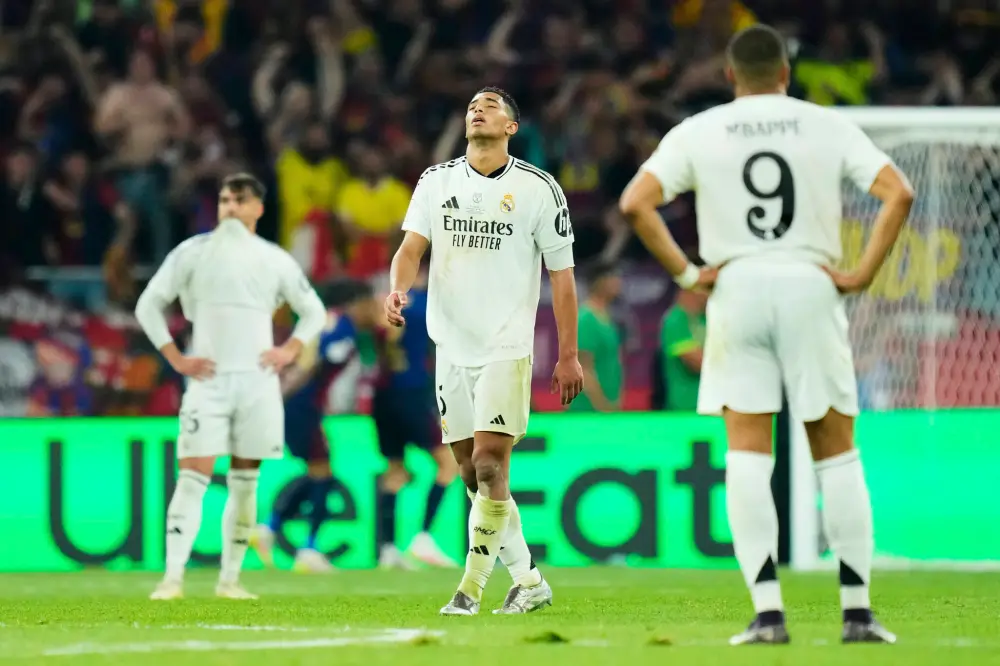
Real Madrid finished second in La Liga, watching Barcelona take the title with relative control. They also lost both the Copa del Rey final and the Supercopa de España final, again to Barcelona, turning what could have been a competitive rivalry into a frustrating pattern of defeats in decisive matches.
In the Champions League, the competition that defines Real Madrid’s identity, the team fell in the quarter finals. It was not a catastrophic failure, but for a club that measures success almost exclusively through trophies, it was not enough.
On paper, the season still included silverware such as the UEFA Super Cup and the Intercontinental Cup. However, in the internal logic of the club and its fans, those trophies did not compensate for losing the major competitions that define prestige and legacy.
What made this season particularly painful was the feeling that the team had enough quality to win everything, yet repeatedly fell short in the decisive moments.
If the first trophyless season felt like an underachievement, the second began to feel like a crisis. By the time the 2025 to 2026 season was underway, the narrative around Real Madrid had shifted. This was no longer a team that simply missed out on titles. It was a team struggling to redefine itself.
One of the most significant changes came off the pitch. Carlo Ancelotti, the most decorated manager in the club’s history, departed at the end of the previous season. His replacement, Xabi Alonso, represented a new era, a younger coach with a different vision, but also someone stepping into an environment where expectations leave no room for gradual development.
At the same time, the squad underwent important changes. Luka Modrić, one of the most influential players in the club’s modern history, left after more than a decade. His departure was was about losing leadership, experience, and the intangible qualities that define winning teams.
Other departures, including players who contributed to the dressing room atmosphere and competitive culture, further weakened the team’s internal structure.
One of the most important explanations for Real Madrid’s struggles lies in something that is difficult to measure but easy to feel: leadership. Reports from within the club highlighted a lack of strong personalities capable of guiding the team through difficult moments.
According to analysis in Spanish media, the team lost key figures such as Toni Kroos, Nacho, and Lucas Vázquez, players who played crucial roles not only on the pitch but also in maintaining discipline and mentality in the dressing room. The younger generation, despite its talent, has not fully replaced that influence.
This absence becomes particularly visible in high pressure matches, where experience often makes the difference between winning and losing. Real Madrid built its reputation on resilience, on comebacks, on surviving moments that would break other teams. Over these two seasons, that identity seemed to fade.
Every successful team eventually faces a transitional phase, and Real Madrid is no exception. The problem is not the transition itself, but how it is managed.
The squad now includes some of the most talented players in the world. Vinícius Júnior continues to be one of the most dangerous attackers in football. Jude Bellingham has established himself as a central figure in midfield. Mbappé, despite the expectations surrounding him, remains a player capable of deciding matches on his own.
And yet, talent alone is not enough. Football at the highest level is about balance, structure, and collective understanding. During these two seasons, Real Madrid often looked like a team still searching for its identity, especially in matches where tactical discipline and cohesion were required.
Another factor that contributed to the trophy drought was the impact of injuries. Key players missed important stretches of the season, disrupting continuity and forcing constant changes in the starting lineup.
In a team already dealing with transition and tactical adjustments, the lack of stability made it even more difficult to build momentum. Even small disruptions can have a significant impact at this level, especially when competing against teams that are more settled and consistent.
While Real Madrid struggled to find its best version, its rivals took advantage. Barcelona, in particular, capitalized on Madrid’s inconsistency, winning domestic competitions and establishing itself as the dominant force in Spain during this period.
In Europe, competition has become more intense than ever. Clubs like Manchester City, Bayern Munich, and others continue to raise the level, making it increasingly difficult to rely solely on history and mentality.
One of the most fascinating aspects of this situation is how expectations shape the perception of success and failure. For most clubs, finishing second in the league and reaching advanced stages in European competitions would be considered a strong season.
For Real Madrid, it is seen as a failure.
This difference is what makes the current situation so significant. The club is not just chasing trophies. It is chasing an identity built on constant victory.
Confidence plays a crucial role in football, and once a team begins to doubt itself, the effects can be difficult to reverse.
Over these two seasons, Real Madrid often looked like a team carrying the weight of expectation. Missed chances, defensive errors, and dropped points created a sense of frustration that seemed to grow as the seasons progressed.
In previous years, the team thrived under pressure. Now, that same pressure appears to have become a burden.
The arrival of Kylian Mbappé was supposed to mark the beginning of a new era of dominance. Instead, it coincided with one of the most challenging periods in recent club history.
This does not mean that Mbappé is the problem. Far from it. But his presence changed the dynamics of the team, both tactically and psychologically.
Integrating a player of his profile requires adjustments, and those adjustments do not always happen immediately. The expectation that he would instantly solve every problem added another layer of pressure to an already complex situation.
Despite everything, writing off Real Madrid would be a mistake. This is a club that has repeatedly shown its ability to rebuild, adapt, and return stronger.
The current situation may actually serve as a turning point. The younger players will gain experience, the tactical ideas will become clearer, and the club will likely make strategic moves in the transfer market to address its weaknesses.
History suggests that periods of struggle are often followed by periods of success.
Two consecutive seasons without major trophies represent a rare and uncomfortable moment for Real Madrid. It is a reminder that even the greatest institutions are not immune to decline, especially during periods of transition.
But it is also a reminder of something else. Football is cyclical. Teams rise, fall, and rise again.



Leave a Reply