
The Champions League has a long history of delivering nights that feel almost unreal, games where momentum swings so violently that even the most experienced players seem caught in the storm. When Bayern Munich and Real Madrid meet, that unpredictability reaches another level. It is a rivalry built over decades, often referred to as the European Clásico, and once again it lived up to everything that reputation promises.
Across two matches, played in Madrid and Munich, Bayern Munich defeated Real Madrid 6-4 on aggregate in a quarter-final tie that never settled into a predictable rhythm. Instead, it unfolded like a story constantly rewriting itself, filled with early shocks, comebacks, individual brilliance, and late drama that ultimately decided everything.
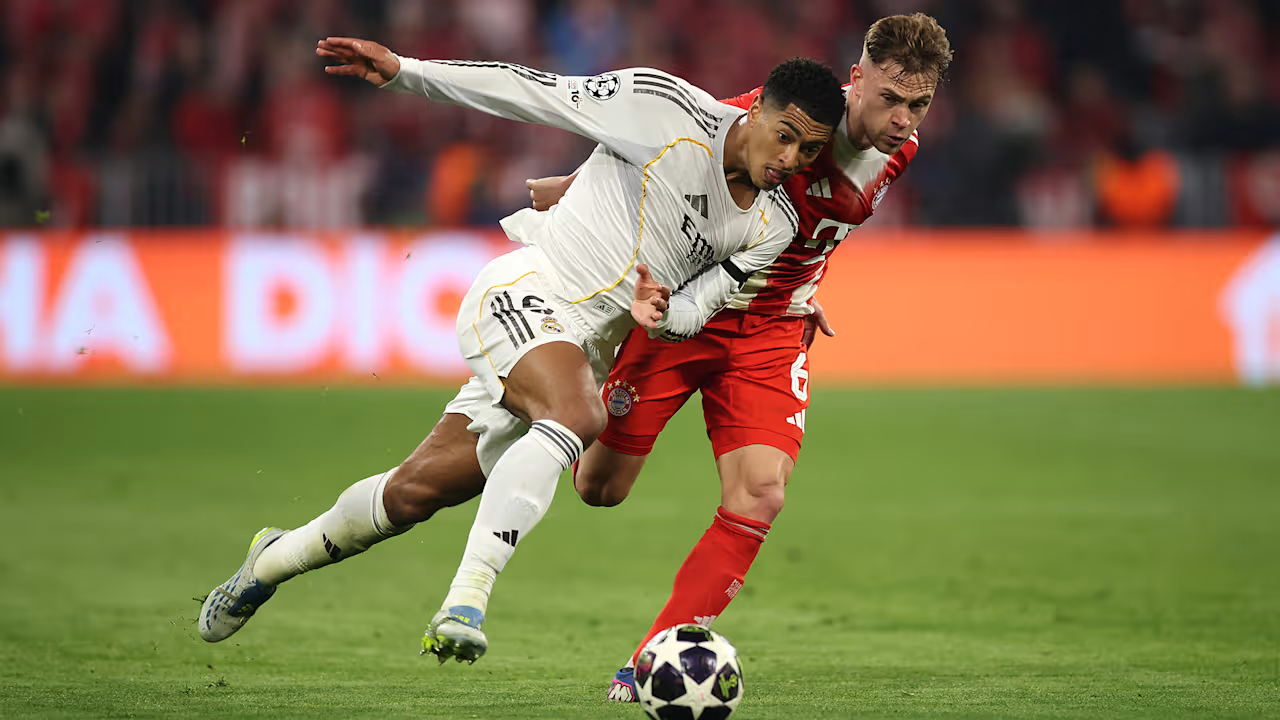
The First Leg in Madrid
The tie began at the Santiago Bernabéu, a stadium where Real Madrid have built their modern Champions League identity on comebacks and control. On paper, Madrid entered the match with a slight psychological edge. Their recent history in the competition, combined with the presence of players like Kylian Mbappé and Jude Bellingham, made them look like favorites in yet another European knockout round.
But Bayern approached the first leg with a clarity that immediately shifted expectations. Rather than sitting back and respecting Madrid’s aura, they played with intensity, pressing high and forcing mistakes. The German side created more chances throughout the match and showed a level of attacking cohesion that Madrid struggled to match.
The breakthrough moments came from Bayern’s ability to strike at key times. Goals from players like Luis Díaz and Harry Kane turned the balance of the game, while Real Madrid found themselves reacting instead of dictating. Despite the home crowd and moments of pressure, Madrid could not fully impose their rhythm.
By the final whistle, Bayern had secured a 2-1 victory away from home, a result that carried enormous weight. Historically, winning the first leg away in a Champions League knockout tie places a team in a very strong position, and Bayern knew exactly what they had achieved.
Still, nobody truly believed the tie was over. If there is one club that has built its identity on overturning deficits, it is Real Madrid.
The Build-Up to the Second Leg
Heading into the return leg at the Allianz Arena, the narrative was clear. Bayern had the advantage, but Real Madrid had belief. The Spanish side needed a result, and their squad was built for nights like this.
There was also a broader context shaping the tension. Bayern had shown attacking dominance in the first leg, generating high-quality chances and controlling large stretches of the match. At the same time, Madrid’s front line had proven they could score quickly and punish even small defensive errors.
Everything pointed toward a second leg that would not be cautious or controlled. It would be open, emotional, and possibly chaotic.
That is exactly what happened.
A Start That Shocked Bayern
If Bayern thought they could settle into the second leg and manage their advantage, Real Madrid had other ideas. The game exploded into life almost immediately.
Within seconds, Madrid capitalized on a mistake from Manuel Neuer, scoring one of the fastest goals imaginable in a Champions League knockout match. It was the perfect start for the visitors, instantly wiping out Bayern’s aggregate advantage and injecting belief into every Madrid player on the pitch.
For a brief moment, the entire dynamic of the tie flipped. Bayern were no longer in control. The pressure shifted entirely onto them.
Bayern Respond, Then Chaos Takes Over
What followed was one of the most frantic first halves seen in recent Champions League history. Bayern responded quickly through Aleksandar Pavlović, restoring balance and reminding everyone that they were not going to collapse under pressure.
But Real Madrid kept coming.
Arda Güler produced a moment of brilliance with a free kick that put Madrid ahead again, and then Kylian Mbappé added another goal before halftime. Each time Bayern equalized, Madrid found a new way to push ahead. It was a sequence of blows and counterblows that felt relentless.
Harry Kane’s goal ensured Bayern stayed alive, but by halftime, the scoreline told a story of pure chaos. Real Madrid had taken the lead multiple times, and yet they still had not managed to pull away completely.
The tie was balanced on a knife’s edge.
After such an explosive first half, the second period slowed slightly, but the tension only increased. Both teams understood that one moment could decide everything.
Bayern pushed forward, trying to regain control, while Madrid looked to exploit spaces on the counterattack. The physical intensity of the match grew, with challenges becoming sharper and emotions more visible.
Then came the turning point.
The Red Card That Changed Everything
In the 86th minute, Eduardo Camavinga was sent off, leaving Real Madrid with ten men. It was the kind of moment that often defines knockout football. Up until that point, Madrid had managed to hold their ground despite the constant back-and-forth.
With one player less, everything became harder.
Bayern immediately sensed the opportunity. The energy inside the Allianz Arena shifted, and the German side pushed forward with urgency, knowing they had a narrow window to take control.
What happened next is exactly why the Champions League remains unmatched in terms of drama.
In the 89th minute, Luis Díaz scored, bringing Bayern level on the night and swinging the aggregate advantage back in their favor. Just minutes later, in stoppage time, Michael Olise added another goal, sealing a 4-3 victory in the second leg and a 6-4 win overall.
What This Means for Both Clubs
By eliminating Real Madrid, Bayern Munich reached their 22nd Champions League semi-final, reinforcing their place among the competition’s elite.
More importantly, they did it in a way that sends a message. This was not a narrow, defensive victory. It was a statement performance built on attacking intent and mental resilience.
Winning a tie like this, especially against a team known for its ability to survive and come back, can reshape a team’s belief. Bayern now move forward knowing they can handle chaos, pressure, and late-game drama.
For Real Madrid, the elimination raises difficult questions. Despite scoring multiple times and leading on several occasions in the second leg, they could not close the tie.
This marks another quarter-final exit in consecutive seasons, a rare situation for a club that has dominated this competition for so long.
At the same time, the performance showed that Madrid remain dangerous. Even in defeat, they demonstrated their ability to create moments and challenge any opponent. The issue was not talent. It was control.
A Rivalry That Keeps Delivering
Matches between Bayern Munich and Real Madrid have always carried a certain weight. With over 30 meetings in the Champions League era, it is one of the most frequent and intense rivalries in European football.
This tie added another unforgettable chapter.
It had everything people expect from elite football. Early goals, tactical adjustments, individual brilliance, red cards, and late winners. More than that, it showed why these two clubs continue to define the Champions League experience.
Looking back at the two legs, it becomes clear that this was never going to be a simple story of one team dominating the other. Instead, it was a contest shaped by momentum swings, small mistakes, and moments of brilliance.
Bayern Munich did not just beat Real Madrid. They survived them.
And in a competition where survival often matters more than control, that might be the most important takeaway of all.



Leave a Reply