
Spain are world champions once again after defeating defending champions Argentina 1 to 0 after extra time in the FIFA World Cup 2026 Final at New York New Jersey Stadium. Sixteen years after lifting their first World Cup trophy in South Africa, the Spanish national team completed another remarkable journey by overcoming Lionel Messi’s Argentina in one of the most tactical and hard fought finals in recent tournament history. Ferran Torres scored the only goal of the match in the 106th minute, finally breaking through an Argentine defense that had resisted relentless pressure for more than one hundred minutes. The victory gave Spain their second FIFA World Cup title and confirmed one of the greatest generations of Spanish football since the famous squad that dominated international football between 2008 and 2012.
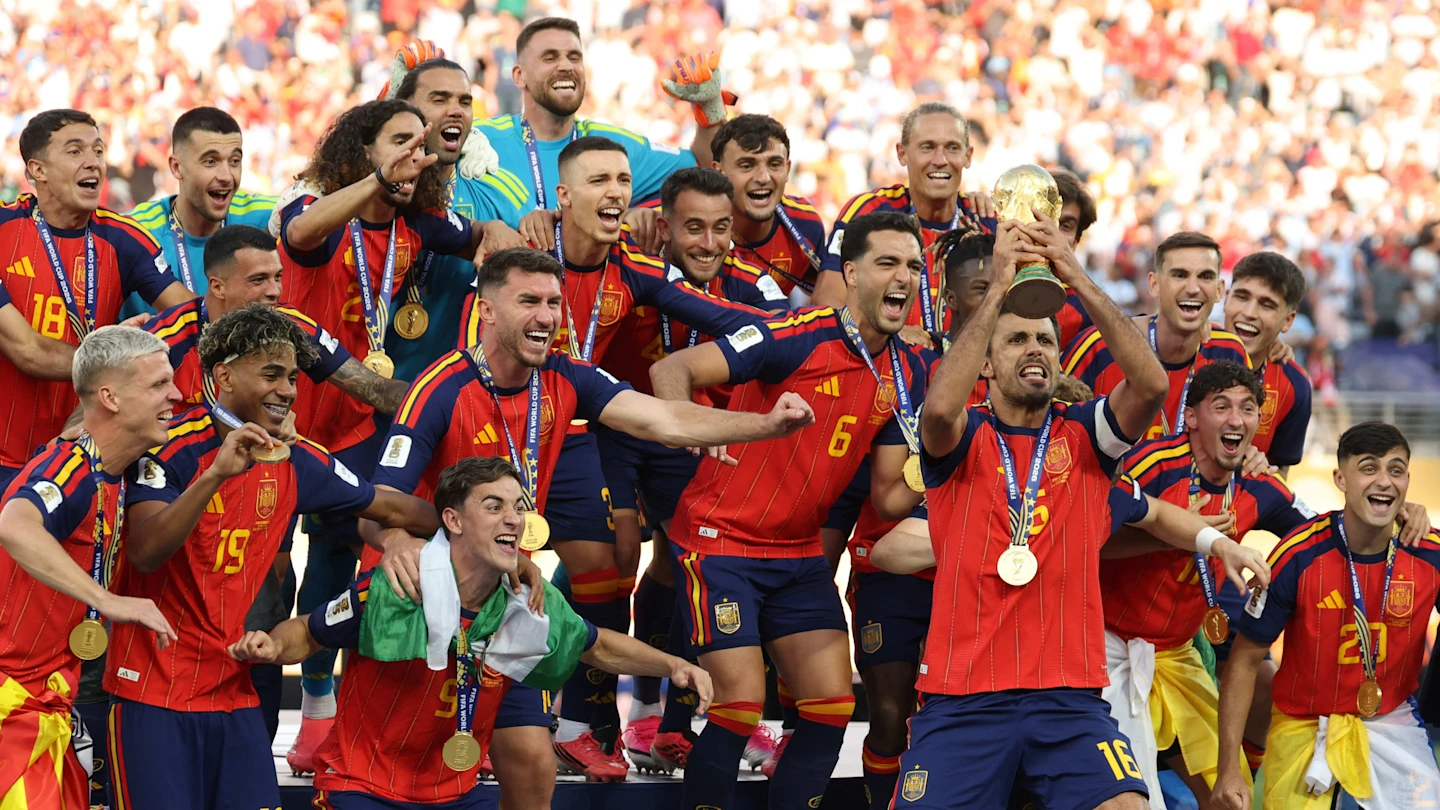
Argentina arrived in New Jersey as the defending world champions after their unforgettable triumph in Qatar four years earlier, while Spain entered the match carrying the confidence of a team that had steadily grown stronger throughout the competition. Luis de la Fuente’s side had impressed from the opening stages of the tournament with technical football, excellent defensive organization and complete control of possession against virtually every opponent they faced. Argentina, led by Lionel Messi in what became his final World Cup appearance, relied on their experience, resilience and ability to survive difficult moments, qualities that had defined the team throughout the knockout stage.
The atmosphere surrounding the championship match reflected the global importance of the event. The 2026 FIFA World Cup became the largest edition ever held, featuring forty eight national teams and more than one hundred matches across the United States, Canada and Mexico. Millions of supporters traveled across North America during the six week tournament while billions followed every stage from around the world. The championship game represented the conclusion of an unprecedented competition that expanded the traditional World Cup format while maintaining the prestige that has made it the biggest event in international football.
Long before kickoff, excitement around the stadium continued to build as thousands of Spanish and Argentine supporters filled every available seat. FIFA organized an elaborate pre match ceremony featuring musical performances and entertainment that reflected the scale of the occasion. The event eventually delayed kickoff by several minutes because of the extensive ceremonies and heightened security arrangements surrounding the attendance of numerous world leaders and celebrities. Despite the slight delay, the anticipation only increased as two of football’s greatest nations prepared to compete for the sport’s most prestigious trophy.
From the opening whistle Spain immediately demonstrated why many analysts considered them the strongest team in the tournament. Rather than allowing Argentina opportunities to settle into possession, Spain pressed aggressively and circulated the ball with remarkable patience. Rodri controlled the rhythm from midfield while Pedri continuously found pockets of space between Argentina’s defensive lines. Nico Williams stretched the Argentine defense on the left side while Lamine Yamal repeatedly forced defenders into difficult situations with his movement and technical ability. Argentina quickly found themselves defending deep inside their own half as Spain established complete territorial control.
Although Spain dominated possession throughout the first half, Argentina managed to survive because of another outstanding performance from Emiliano Martínez. The goalkeeper repeatedly denied Spanish opportunities and displayed the same composure that had helped Argentina become world champions four years earlier. Every save increased Argentine confidence while simultaneously frustrating Spanish attackers who continued searching for an opening. Martínez produced one of the finest goalkeeping displays ever seen in a World Cup final, keeping Argentina alive despite the overwhelming pressure applied by Spain throughout normal time.
Lionel Messi entered the match hoping to conclude his extraordinary World Cup career with consecutive titles, but Spain’s defensive organization rarely allowed him opportunities to influence the contest. Every time Messi attempted to receive possession between the lines, Spanish midfielders immediately surrounded him while defenders closed every passing lane. Rather than allowing the Argentine captain time to create chances, Spain forced him into deeper positions where he could not threaten the penalty area. The tactical discipline shown by Luis de la Fuente’s players became one of the defining features of the final and prevented Argentina from developing any sustained attacking momentum.
As the second half progressed it became increasingly apparent that Spain were dominating almost every statistical category. They enjoyed the overwhelming majority of possession, completed far more passes and continually forced Argentina into desperate defensive actions. Remarkably, Argentina failed to register a meaningful attacking effort for much of the contest, an illustration of how completely Spain controlled the rhythm of the match. Luis de la Fuente resisted making dramatic tactical changes because his team was executing the game plan almost perfectly. The only missing ingredient was the decisive finish that would finally beat Martínez, whose performance was rapidly becoming one of the greatest goalkeeping displays ever seen in a World Cup final.
The match became even more difficult for Argentina late in normal time when Enzo Fernández received a red card, leaving the defending champions with ten players before extra time. Losing one of their most influential midfielders made an already demanding challenge even greater, forcing Lionel Scaloni’s side to defend with even fewer options against a Spanish team that never stopped attacking. Although Argentina showed determination and commitment, playing with ten men only increased the physical and mental demands placed upon a squad that had already spent almost ninety minutes chasing the ball.
Extra time began with Spain refusing to settle for penalties. Rather than becoming cautious, they continued moving the ball patiently from side to side while searching for a weakness in Argentina’s defensive structure. That breakthrough finally arrived in the 106th minute. Pedro Porro delivered a deep cross into the penalty area where Nico Williams intelligently headed the ball back across goal. Ferran Torres reacted first, meeting the pass with a composed finish that finally beat Emiliano Martínez and sent Spanish players, coaches and supporters into celebration. After more than one hundred minutes of relentless pressure, Spain had finally earned the goal that reflected their dominance throughout the evening.
The closing minutes became increasingly emotional as Argentina desperately searched for an equalizer despite playing with ten men. Spain managed possession intelligently, limiting Argentina’s opportunities while protecting their narrow advantage. According to match reports, Argentina did not produce a genuine shot on target until very late in extra time, illustrating just how effectively Spain neutralized every attacking threat. When the final whistle sounded, Spanish players collapsed onto the pitch in celebration while Argentine players were left devastated after falling just short of retaining the World Cup title.
The celebrations were briefly overshadowed by ugly scenes after the match as tensions boiled over between players from both teams. Several confrontations occurred on the field, resulting in another dismissal for Argentina when Leandro Paredes was shown a red card. Reports described pushing, shoving and altercations involving multiple players before security and team staff restored order. Despite the chaotic ending, Lionel Messi was widely praised for maintaining his composure during the incidents as Spain prepared to lift the trophy.
Spain’s triumph represented the country’s second FIFA World Cup title after their historic victory in 2010. Luis de la Fuente added another remarkable achievement to his coaching career, guiding a talented generation to football’s biggest prize through a tournament defined by technical excellence, tactical discipline and outstanding defensive organization. Throughout the competition Spain conceded very few opportunities, controlled possession against virtually every opponent and consistently demonstrated why many observers considered them the most complete team in the tournament.
Individual Awards at the 2026 FIFA World Cup
Spain’s dominance throughout the tournament was reflected in the post tournament awards, with three Spanish players receiving FIFA’s biggest individual honors after lifting the World Cup trophy. France’s Kylian Mbappé was the only player to prevent Spain from sweeping every major award, finishing as the tournament’s leading scorer.
Golden Ball: Rodri (Spain)
Rodri was named the winner of the Golden Ball, the award presented to the best player of the tournament. The Spanish midfielder was the heartbeat of Luis de la Fuente’s side from the opening match through the final, controlling possession, dictating the tempo and providing the balance that allowed Spain’s talented attacking players to flourish. His calmness under pressure, tactical intelligence and consistency made him one of the standout performers of the competition, and he capped the tournament by leading Spain to a 1 to 0 extra time victory over Argentina in the final. Rodri’s performances throughout the World Cup earned widespread praise from analysts and supporters, making him a deserving recipient of FIFA’s highest individual honor.
Golden Glove: Unai Simón (Spain)
Spain goalkeeper Unai Simón received the Golden Glove as the best goalkeeper of the tournament after an outstanding campaign. Spain built their World Cup winning run on one of the strongest defenses in the competition, and Simón played a crucial role whenever he was called into action. Although Spain dominated possession in many of their matches, the Athletic Club goalkeeper consistently produced important saves during key moments and remained composed under pressure. His clean sheet in the final against Argentina completed a remarkable tournament and helped secure Spain’s second FIFA World Cup title.
Best Young Player: Pau Cubarsí (Spain)
Spain defender Pau Cubarsí was named the Best Young Player of the 2026 FIFA World Cup after an exceptional breakthrough tournament. Despite his young age, Cubarsí displayed remarkable maturity throughout the competition, becoming one of the foundations of Spain’s outstanding defensive record. His composure on the ball, intelligent positioning and ability to read the game impressed FIFA’s Technical Study Group, which selected him as the tournament’s best young talent. Winning the award confirmed Cubarsí as one of the brightest defensive prospects in world football and highlighted the exciting future of the Spanish national team following their World Cup triumph.
Golden Boot: Kylian Mbappé (France)
France captain Kylian Mbappé won the Golden Boot after finishing as the tournament’s top scorer with ten goals. Although France were eliminated by Spain in the semifinals, Mbappé’s incredible scoring form throughout the competition ensured that no other player could overtake him before the tournament concluded. The award further strengthened his already extraordinary World Cup legacy, making him the first player to win the Golden Boot on two separate occasions after also claiming the honor in Qatar in 2022. Despite missing out on the World Cup trophy, Mbappé once again proved himself to be one of international football’s most prolific goalscorers.



Leave a Reply