
Dating is rarely simple. Add migration, cultural identity, family expectations, geography and different ideas about what a relationship is supposed to become, and it can become considerably more complicated.
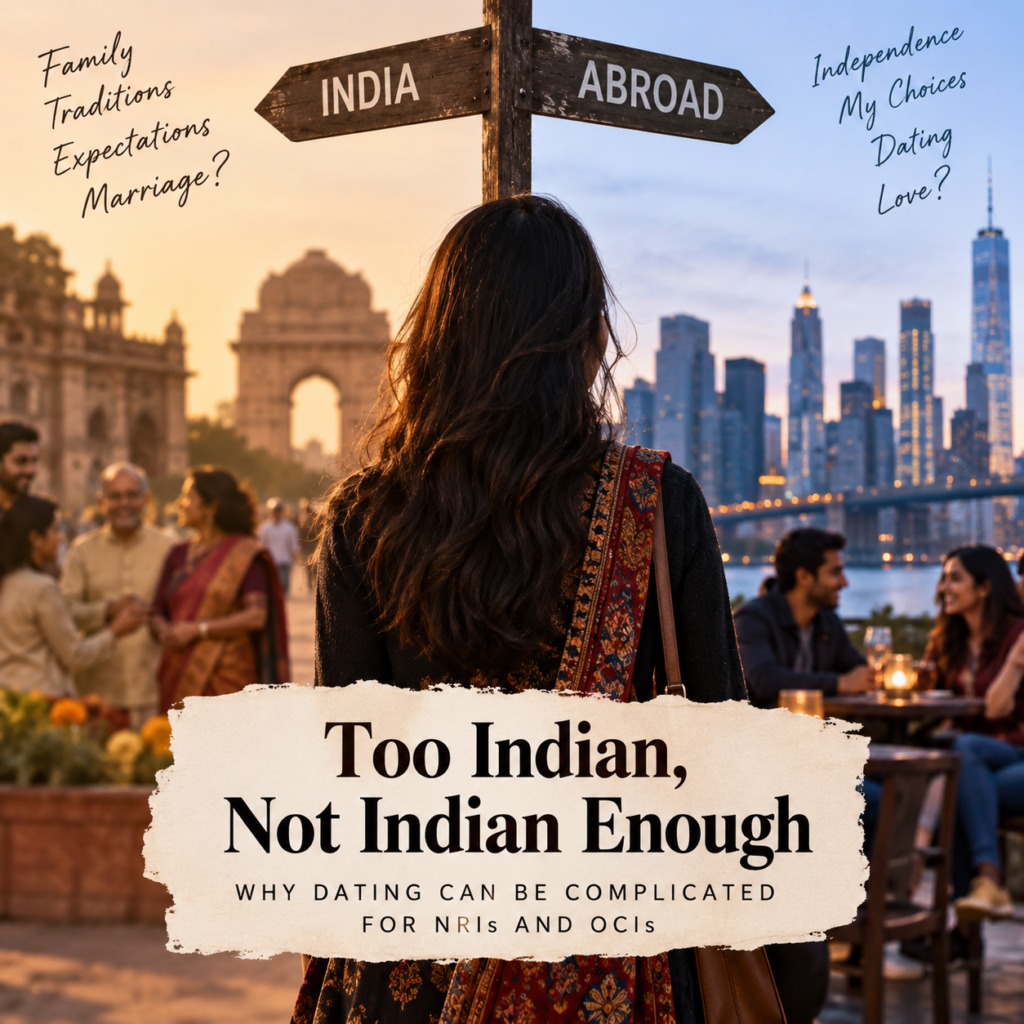
For many Non-Resident Indians (NRIs), Overseas Citizens of India (OCIs) and people of Indian origin who have built their lives abroad, dating can involve navigating two worlds at the same time.
Someone might have grown up in London, Toronto, New York or Sydney while remaining closely connected to Indian culture at home. Another person may have spent most of their life in India before moving abroad for university or work. Both may describe themselves as Indian, yet their expectations around dating, relationships and marriage can be remarkably different.
That creates a dating experience that doesn’t always fit neatly into either mainstream Western dating culture or traditional Indian matchmaking.
When Two People Share a Culture — But Not Necessarily the Same Experience
At first glance, meeting another Indian abroad might appear to solve the cultural compatibility question.
It doesn’t always.
An Indian who moved to Britain at 27 may have a very different experience from someone born in Birmingham to Indian parents. A second-generation Indian American may have grown up negotiating Indian traditions at home and American culture everywhere else. Someone who has recently moved from Mumbai to Toronto may approach relationships differently again.
Language, religion, region and family background add further layers.
Two people can therefore tick the same broad demographic boxes and still discover that they have very different ideas about dating.
For some people, this is liberating. They don’t particularly care whether their partner shares their cultural background.
For others, cultural understanding matters enormously.
The difficulty is finding someone who understands the distinction.
“Too Indian” in One Room, “Not Indian Enough” in Another
One of the peculiar experiences of growing up between cultures is discovering that identity can depend on who is looking at you.
Among friends in Britain or America, someone might simply be regarded as Indian.
Among relatives in India, that same person might be regarded as British or American.
Their accent may sound Indian to one group and foreign to another. Their attitude towards relationships may appear conservative to some friends and unusually liberal to relatives.
Dating can expose these contradictions very quickly.
A person may want independence in choosing a partner while still caring deeply about their family’s opinion. They may happily date but view marriage as a much more culturally significant decision. They may not practise a religion particularly closely but still prefer a partner who understands it.
None of those positions is necessarily contradictory.
They are often simply what happens when someone’s identity has been shaped by more than one culture.
Then There Is the Family
For many people, dating is principally a decision between two individuals.
For some Indian families, however, a serious relationship eventually becomes something involving two families.
That doesn’t necessarily mean parents choosing someone’s husband or wife.
Modern Indian relationships exist across an enormous spectrum. Some people want completely independent dating lives. Others actively want their parents involved. Many fall somewhere between the two.
The complication comes when two people occupy different positions on that spectrum.
One person may think meeting the parents means, “We’re becoming serious.”
The other person’s family may interpret the same meeting as, “Marriage discussions have begun.”
Questions that might normally emerge after months of dating can therefore appear surprisingly early.
Where would you live?
Would you move countries?
Do you want children?
How important is religion?
Would your parents accept someone from another community?
Is marriage actually what you’re looking for?
For people casually exploring a relationship, that can feel intense. For someone actively seeking marriage, asking those questions early may feel entirely sensible.
Neither approach is inherently wrong.
But mismatched expectations can end relationships before they have really begun.
Dating for Fun or Dating for Marriage?
This may be one of the biggest differences between mainstream dating apps and the experience of some Indians abroad.
People use dating apps for very different reasons.
One person wants to meet interesting people. Another wants a relationship but isn’t thinking about marriage. Another is specifically looking for a life partner. Someone else may simply want friendship after moving to a new country.
When those intentions aren’t clear, frustration follows.
This is hardly unique to Indians. Dating apps everywhere struggle with mismatched intentions.
But cultural expectations can amplify the problem.
Someone approaching 30 may suddenly find that conversations with relatives increasingly revolve around marriage. Weddings during trips to India can become accompanied by the inevitable questions about when their own turn will come.
Meanwhile, their actual dating life may still operate within the much less structured world of modern apps.
They effectively find themselves navigating two relationship systems simultaneously.
The Mainstream Dating App Problem
Large dating apps have one obvious advantage: enormous numbers of people.
But scale doesn’t necessarily make finding a culturally compatible person easier.
Imagine an Indian professional living in Manchester who would like to meet another person of Indian origin, ideally someone living in Britain, who is looking for a serious relationship and understands the experience of having family spread between Britain and India.
That person may exist on a mainstream dating app.
The problem is finding them.
Most mainstream apps weren’t primarily designed around diaspora identity. Their discovery systems tend to emphasise factors such as age, distance, gender and broad relationship preferences.
For many users, that’s perfectly sufficient.
For someone searching across a geographically dispersed diaspora, it may not be.
The person they would be highly compatible with could live 70 miles away rather than seven. Or they could be in another city, another part of the country or even another country entirely.
When your potential community is spread around the world, proximity isn’t always the most useful starting point.
But Traditional Matrimonial Sites Can Feel Like the Opposite Extreme
For decades, matrimonial services helped Indians find partners long before swiping became part of the vocabulary of romance.
They remain enormously important, particularly for people explicitly seeking marriage.
But not every Indian abroad who wants cultural compatibility wants to enter a process that feels like matrimonial matchmaking.
Someone might want a serious relationship while still wanting that relationship to develop organically.
Someone else may want companionship or friendship.
Others simply aren’t ready to describe every promising conversation as a potential marriage.
This leaves an interesting space between two established models.
At one end are mainstream dating apps built for very broad populations.
At the other are traditional matrimonial platforms built primarily around marriage.
A growing number of diaspora Indians live somewhere between them.
Geography Makes Everything Harder
The Indian diaspora is enormous, but it isn’t evenly distributed.
There are substantial communities across the United Kingdom, United States, Canada, Australia, the Gulf, Singapore and many other countries.
Even within those countries, communities can be concentrated in particular cities and regions.
That creates an unusual dating problem.
Someone may be surrounded by millions of people and still have a relatively small pool of potential partners who match what they’re actually looking for.
Expanding the search radius helps, but then another problem appears: distance.
Long-distance relationships between London and Manchester are one thing.
London and Toronto are another.
For NRIs, international relationships can quickly raise questions most couples don’t encounter until much later.
Who moves?
Whose career takes priority?
What happens to immigration status?
Where will children grow up?
How often will you visit India?
Where are ageing parents?
A relationship can have extraordinary emotional compatibility and still collide with geography.
The Assumptions Can Be Exhausting Too
Dating outside your cultural background can be wonderful, and millions of happy relationships prove that cultural differences are hardly an insurmountable barrier.
But intercultural dating can sometimes bring unwanted assumptions.
Indian women may encounter stereotypes about being conservative, submissive or controlled by their families.
Indian men can face their own stereotypes surrounding masculinity, dating behaviour or family expectations.
Then there are questions that may be asked innocently but become tiring after the twentieth time.
“Will your parents choose who you marry?”
“Would your family accept me?”
“Do you have to marry another Indian?”
“Wasn’t your parents’ marriage arranged?”
Sometimes those conversations become opportunities to understand each other better.
Sometimes they simply make someone feel as though they’re explaining their identity rather than enjoying a date.
And there is an important distinction between someone being genuinely interested in another person’s culture and being interested in them because of assumptions about that culture.
Nobody wants to feel like a demographic preference rather than a person.
Even “Indian” Is an Extremely Broad Label
Another problem with talking about Indian dating as though it were a single experience is that India itself is extraordinarily diverse.
Punjabi isn’t Gujarati.
Gujarati isn’t Bengali.
Bengali isn’t Tamil.
Tamil isn’t Telugu.
Religion, language, food, customs and family traditions can differ enormously.
And diaspora communities create further variations.
A Punjabi family that has lived in Britain for three generations may have a different cultural experience from a Punjabi family that moved to Britain five years ago.
This is why cultural compatibility cannot simply mean matching two people labelled “Indian.”
For some people, region and language are important.
For others, they’re irrelevant.
Some care about religion.
Some explicitly don’t.
Some want a partner deeply connected to Indian culture.
Others simply want someone who understands what it’s like to have one foot in more than one world.
The important part is having the freedom to decide which of those things actually matter.
A Different Kind of Diaspora Dating Is Emerging
These frustrations are one reason more specialised dating communities have begun appearing alongside the huge global apps.
Rather than attempting to replace mainstream dating or traditional matrimony, diaspora-focused platforms occupy a narrower space.
One example is NRI Dating, a platform designed around NRIs, OCIs and Indians living around the world.
Its premise reflects a broader shift in online dating: sometimes people don’t necessarily want more profiles. They want a more relevant pool of people and better ways to express what they’re actually looking for.
That doesn’t mean every NRI should date another NRI.
Far from it.
Many people actively prefer dating outside their cultural background, and cultural similarity by itself guarantees absolutely nothing about compatibility.
But people who do consider shared experience important increasingly expect dating technology to let them express that preference without forcing them into a traditional matrimonial model.
That’s a subtle but significant difference.
Perhaps the Real Issue Isn’t Finding Someone Indian
It is easy to describe diaspora dating as a search for someone from the same culture.
The reality is more interesting.
What many people appear to be searching for isn’t necessarily someone exactly like themselves.
They’re looking for someone who understands them.
Someone who doesn’t require a lengthy explanation of why you can be fiercely independent and still care what your parents think.
Someone who understands why a trip to India isn’t necessarily a holiday.
Someone who knows that being culturally Indian doesn’t dictate your politics, religion, personality or relationship choices.
Someone who understands why marriage can simultaneously be an intensely personal decision and something that matters deeply to an extended family.
That person might be Indian.
They might not be.
But understanding the experience matters.
Dating Between Two Worlds Doesn’t Have to Mean Choosing One
The story of the Indian diaspora has always involved adaptation.
People move. Cultures mix. Traditions change. Children grow up differently from their parents. New relationships create families containing identities that previous generations could scarcely have imagined.
Dating is simply another place where that evolution becomes visible.
For NRIs and OCIs, finding love can sometimes mean negotiating questions that other couples encounter less frequently: culture, geography, immigration, family expectations and the meaning of marriage itself.
But being between cultures isn’t merely a complication.
It can also broaden what people expect from relationships.
Someone can value Indian traditions without allowing those traditions to dictate whom they love. They can want their family’s approval without surrendering their own choice. They can seek someone from a similar background—or someone completely different.
Modern diaspora dating isn’t about choosing between being Indian and being Western.
Increasingly, it’s about being comfortable enough with both worlds to decide for yourself what matters.
And perhaps that’s why the hardest question isn’t really:
“How do I find another Indian?”
It’s:
“How do I find someone who understands the person I’ve become?”



Leave a Reply