

The theatrical debut of Spider-Man: Brand New Day marks one of the most monumental milestones in modern blockbuster history. Serving as the thirty-eighth cinematic chapter within the overarching Marvel Cinematic Universe and standing proudly as the fourth direct installment in Tom Holland's headlining saga, this production delivers a massive creative renaissance for Marvel Studios, Columbia Pictures, and Pascal Pictures. Clocking in at a gripping runtime of one hundred and forty-five minutes, the motion picture arrived on global cinema screens under the direction of Destin Daniel Cretton, celebrated for his dynamic visual storytelling in Shang-Chi and the Legend of the Ten Rings. It explores an entirely new chapter in the life of Peter Parker, presenting an isolated vigilante who must navigate grief, absolute anonymity, evolving biological mutations, and a complex urban crime war without the safety net of high-tech mentorship or Avengers-level funding.
The foundation for this narrative transition was cemented in the unforgettable finale of Spider-Man: No Way Home, where Peter Parker made the profound moral sacrifice to have Doctor Strange cast an irreversible memory-wiping incantation across the entire universe to prevent an interdimensional collapse. That climactic spell erased Peter Parker from the memories of every living human, including his beloved girlfriend Michelle "MJ" Jones-Watson, his loyal confidant Ned Leeds, and the rest of Earth's Mightiest Heroes. By abandoning his personal identity to protect the fabric of reality, Peter entered a bleak, lonely existence in an austere Manhattan apartment, equipped only with a sewing machine to stitch together a classic fabric suit and a radio tuned to emergency police frequencies. Spider-Man: Brand New Day picks up the emotional weight of that devastating sacrifice, drawing thematic inspiration from the controversial yet transformative two-thousand-and-eight comic book arc created by Dan Slott, Bob Gale, Marc Guggenheim, and Zeb Wells. In doing so, the film re-establishes the character as the quintessential friendly neighborhood protector who patrols the alleys, fire escapes, and rooftops of New York City.
To truly appreciate the thematic scope of this production, one must examine the lineage of Peter Parker's modern cinematic journey across the Marvel Cinematic Universe. When Tom Holland first debuted in Captain America: Civil War, audiences met an enthusiastic teenager discovered by Tony Stark, quickly catapulted into global conflicts that took him from Queens to German airports, space cruisers, and distant alien worlds. In Spider-Man: Homecoming, director Jon Watts presented a vibrant high-school coming-of-age story where Peter grappled with the burden of proving himself to the Avengers while facing the Vulture. The subsequent follow-up, Spider-Man: Far From Home, thrust Peter into a grieving post-Endgame world across Europe, forcing him to confront the manipulative machinations of Mysterio, which culminated in the public unmasking of his secret identity. Finally, No Way Home served as a multiverse celebration that united three distinct generations of live-action Spider-Men, allowing Tobey Maguire, Andrew Garfield, and Tom Holland to share the screen while bringing Holland's origin trilogy to a tragic, grounded close. Spider-Man: Brand New Day represents the first chapter of a mature second trilogy conceived by producers Kevin Feige and Amy Pascal, setting aside the adolescent reliance on billionaire gadgets to explore the harsh realities of adult life.
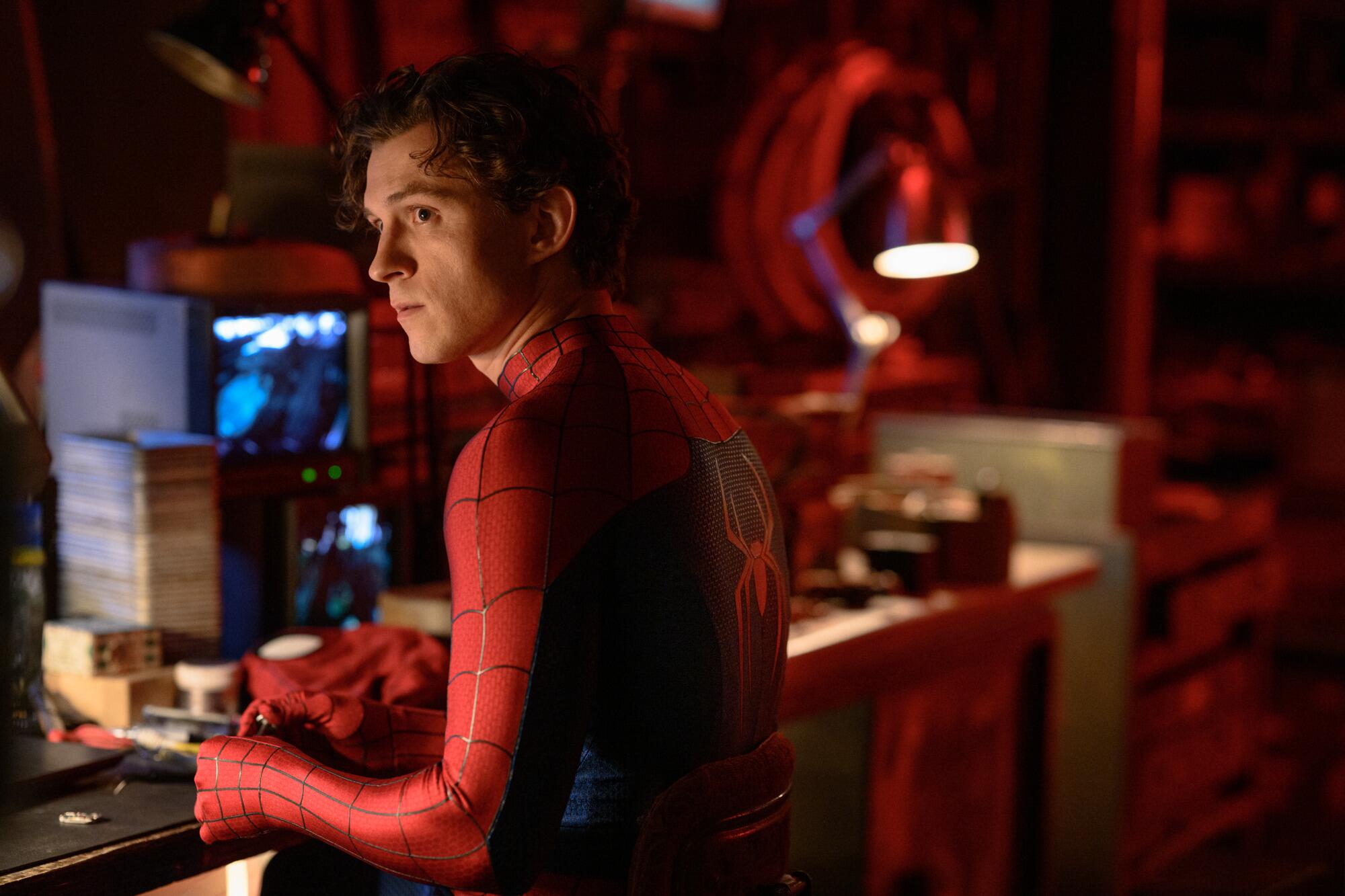
The performance delivered by Tom Holland in this entry stands as the most accomplished of his career, showcasing an actor who has fully grown alongside his iconic alter ego. Holland portrays a Peter Parker who is completely consumed by guilt and hyper-focused on duty, dedicating every waking hour to street patrol to suppress his lingering emotional trauma. As the character works through extreme physical exhaustion and sleep deprivation, his arachnid biology undergoes a startling physical mutation reminiscent of the comic book storylines. His reflexes sharpen, his eyes flash pitch-black during heightened combat distress, and his body develops natural spinnerets in his wrists, granting him organic webbing that mirrors the classic live-action incarnation originally portrayed by Tobey Maguire. Holland infuses the role with a deep sense of internal conflict, balancing the physical athleticism of intense hand-to-hand fight choreography with quiet, vulnerable moments of sorrow as he watches the people he loves live happy lives without him.
Returning alongside Holland, Zendaya delivers an exceptional and layered turn as Michelle "MJ" Jones-Watson. Having graduated from the Massachusetts Institute of Technology alongside Ned Leeds, MJ returns to New York City to pursue her creative and academic ambitions. Zendaya worked alongside the screenwriters to maintain the observant wit and eccentric quirks that define MJ, while incorporating the maturity of a young woman embarking on independent adulthood. Her dynamic with Peter is tragic, as Peter repeatedly catches glimpses of her thriving in the city, even witnessing her in a new romantic relationship. This emotional barrier creates immense internal friction for Peter, highlighting the heartbreaking cost of his heroism while keeping their emotional connection grounded in authenticity rather than convenient plot devices.
Jacob Batalon reprises his role as Ned Leeds, completing his transition from the enthusiastic guy in the chair to an accomplished young professional finding his own voice. The dynamic between Peter and Ned offers several of the film's most touching scenes, especially when Peter briefly crosses paths with Ned and experiences the emotional sting of a forgotten friendship. Batalon infuses his scenes with natural warmth and subtle dramatic weight, grounding the broader superhero elements in genuine human stakes. The film also features Marisa Tomei in deeply moving memory sequences that reinforce the enduring moral philosophy of Aunt May, reminding Peter that true responsibility requires an unwavering commitment to helping others even when the personal cost is devastating.
The ensemble cast expands significantly through electrifying guest appearances and new character introductions that anchor the story firmly within the gritty underbelly of New York City. Jon Bernthal makes an explosive return as Frank Castle, the Punisher, bringing his uncompromising tactical intensity into direct ideological conflict with Peter Parker's non-lethal code of justice. Florence Pugh returns as Yelena Belova, delivering lethal espionage capability as she investigates black-market corruption tied to the Department of Damage Control. Sadie Sink joins the Marvel Cinematic Universe in an enigmatic role that captivates audiences, bringing mysterious telepathic layers to the city's unfolding narrative. The legendary Mark Ruffalo makes an impactful appearance as Bruce Banner, offering scientific insight and emotional guidance as Peter struggles to understand the physiological changes coursing through his altered body. Supporting turns from Tramell Tillman and Liza Colón-Zayas as veteran detective Jean DeWolff provide the police precinct with authentic grit and dramatic authority.
The theatrical run of Spider-Man: Brand New Day has rewritten the global box office record books, solidifying the web-slinger as the undisputed titan of theatrical exhibition. Produced against a substantial production budget of two hundred and twenty-five million dollars, the film generated explosive worldwide anticipation leading up to its premiere at the prestigious Dolby Theatre in Hollywood. Upon wide theatrical release, the movie obliterated industry projections by posting historic opening weekend grosses across North America, Europe, Latin America, and Asia. The production surged past the two billion dollar mark in record time, accumulating an astonishing global box office total of over two billion two hundred million dollars. This unprecedented commercial run makes it the highest-grossing film of its release year, the single highest-grossing Spider-Man film ever made, and one of the top five highest-grossing cinematic releases in the history of the medium.
Critical reception across major review publications has been overwhelmingly glowing, with journalists and critics celebrating the film's willingness to embrace dramatic maturity, emotional consequence, and kinetic street-level stakes. Audiences and comic enthusiasts have universally praised the balance of spectacular action set pieces and rich character development, highlighting Tom Holland's deep dedication to the role and the seamless integration of classic Marvel characters. Spider-Man: Brand New Day does not merely entertain; it elevates the superhero genre by demonstrating how an iconic character can evolve, mature, and endure across decades of cinematic history.
Beyond the overarching storyline and the primary cast members, the gritty world-building of this installment pulls directly from some of the darkest corners of New York crime lore. The narrative plunges headfirst into the chaotic power vacuum tearing through the five boroughs, where criminal factions clash over illicit weapons caches salvaged from previous superhuman battles. Instead of relying on grandiose alien technology, the antagonists operate through back-alley armories, smuggling operations, and tactical street warfare. This forces Spider-Man to rely on pure detective instinct, listening in on police radio chatter, following paper trails through underground chop shops, and stalking suspects across rain-soaked rooftops. The atmosphere carries the heavy, raw texture of a classic crime thriller, showing the exhaustion of a young vigilante who must stitch his own wounds with cheap medical kits, patch up torn fabric suits by hand, and live off corner bodega coffee while barely scraping together enough rent for his tiny run-down room.
The philosophical clash between Spider-Man and the Punisher provides some of the rawest dramatic tension ever seen on screen. Frank Castle views Peter's strict rule against taking a human life as naive weakness that allows dangerous predators to return to the streets over and over again. Their brutal rooftop fights do not look like choreographed superhero dances; they are messy, exhausting brawls where every punch, broken window, and tactical trap carries actual physical consequence. Peter finds himself battered and bruised, desperately trying to protect criminals from lethal sniper rounds while defending his own moral core. This dynamic pushes Peter to the brink of psychological collapse, forcing him to question whether showing mercy actually protects the innocent people of the city or simply prolongs their suffering in an endless cycle of urban violence.
The inclusion of Yelena Belova brings an entirely different flavor to the underworld investigation, weaving sharp wit and tactical espionage into the street-level chaos. Her covert mission tracking stolen military gear constantly collides with Peter's neighborhood stakeouts, leading to impromptu team-ups filled with natural, sarcastic banter and razor-sharp combat synergy. Yelena treats Peter like an overworked kid who needs to eat a sandwich and get some real sleep, yet she deeply respects his acrobatic prowess and tactical resourcefulness. Their dynamic showcases how two completely different operational styles can collide, combining the silent efficiency of a trained black-ops assassin with the loud, kinetic acrobatics of an agile web-slinger dodging gunfire inside cramped warehouse storage units.
The psychological toll on Peter Parker is explored in detail through haunting dream sequences and overwhelming auditory hallucinations. Stripped of his high-tech artificial intelligence earpieces and Stark satellite tracking, Peter must endure the full, unfiltered power of his superhuman senses. The buzzing sensory overload of his spider-sense is portrayed through disorienting sound design, with piercing high-frequency tones, muffled ambient noise, and sudden heartbeat spikes that put the audience right inside his frantic head. When his body begins to change biologically, the physical terror of sprouting organic web glands in his arms creates genuine body-horror elements, showing how frightening these arachnid abilities can be when they manifest without high-tech regulators or scientific stabilization.
The stunt work deserves massive recognition, featuring a dedicated team of parkour athletes, martial artists, and gymnasts who performed complex wire maneuvers and practical free-falls across real industrial locations. The film minimizes green-screen environments during high-speed chases, opting to suspend stunt doubles from real construction cranes above city blocks to capture authentic wind resistance, momentum, and vertigo-inducing camera angles. This commitment to physical staging gives every web-swing, wall-run, and sudden drop an intense sense of real-world gravity, making the audience physically feel the danger of swinging hundreds of feet above busy concrete avenues.
The cinematography throughout the entire second half leans heavily into natural night lighting, practical street lamps, and flickering neon signs that give the city an authentic, lived-in grit. Cinematographer Brett Pawlak deliberately avoided over-polishing the visual palette, utilizing specialized anamorphic camera lenses that capture realistic lens flares, wet pavement reflections, and genuine atmospheric haze drifting up from New York sewer grates. When Spider-Man perches high atop bridge cables or the gargoyles of aging cathedrals, the skyline behind him feels vast and indifferent, visually emphasizing how small one person is compared to the sprawling urban jungle beneath his feet. This stark visual grammar reinforces the emotional core of the film, making every patrol feel cold, grueling, and physically demanding.
The underground criminal ecosystem introduced in this story extends far beyond typical bank robbers, showcasing organized syndicates that actively exploit the chaos left behind by missing vigilantes and overburdened local law enforcement. Corrupt city officials, black-market arms dealers, and rogue private security contractors operate in broad daylight, using shell corporations and counterfeit shipping manifests to traffic dangerous weapon prototypes right under the nose of City Hall. Peter has to spend hours going through physical paper archives, tracking delivery trucks on foot, and piecing together financial trails on a crowded corkboard pinned to his bedroom wall. This return to shoe-leather detective work strips away the effortless digital hacking of previous entries, proving that true heroism requires patience, critical thinking, and relentless investigative labor.
The sound design team pushed the sonic immersion to incredible new heights, using binaural audio recording techniques to place viewers directly inside the intense acoustic chaos of a crowded city block. Every distant police siren, screeching subway brake, echoing gunshot in a concrete stairwell, and heavy drop of rain hitting fabric carries distinct spatial weight. During fast-paced pursuit sequences through narrow alleyways, the sound of tearing cloth, heavy breathing through the fabric mask, and the sharp mechanical snap of organic web fluid shooting from wrists under intense hydraulic pressure gives the action an almost uncomfortably tangible presence. The auditory contrast between the noisy, suffocating bustle of midtown Manhattan and the dead silence of Peter's empty room after midnight highlights the profound isolation that defines his daily routine.
The narrative also takes time to highlight the everyday citizens of the city, giving meaningful screen time to regular people who deal with the consequences of superpowered violence on their doorsteps. Bodega owners, subway conductors, hospital nurses, and street vendors are not just background decoration; they interact with Peter, offer him shelter during sudden police sweeps, and occasionally hand him a warm meal when they notice how visibly exhausted he looks. These quiet, humanizing interactions showcase why Spider-Man continues to fight despite having no personal life left. The citizens do not view him as an untouchable celebrity or an untouchable god; they see him as a dedicated neighbor who bleeds on their sidewalks and gets back up every single time to keep their families safe.
The costume design department faced unique challenges when creating the physical wardrobe for a hero working on a micro-budget. Instead of a single indestructible suit, the production team created dozens of slightly altered versions of the classic red and blue outfit to reflect realistic wear, tear, and field repairs. Viewers can visibly spot uneven stitching along the seams, mismatched thread colors where Peter had to quickly mend knife cuts, and worn-out grip padding on the fingertips and boots from scaling rough brick surfaces. This obsessive attention to realistic detail gives the costume a tangible, handmade personality that honors the working-class origins of the comic book source material.
Looking toward the broader industry landscape, the creative and commercial execution of this project has ignited widespread discussion among filmmakers, critics, and studio executives about the viability of character-driven superhero cinema. By scaling down the cosmic stakes and focusing heavily on personal consequence, physical vulnerability, and uncompromising moral dilemmas, the creative team proved that audiences still crave deeply human, grounded storytelling. This production establishes a high benchmark for future comic book adaptations, showing that emotional depth, practical stunt work, and rich narrative texture can deliver a profound cinematic experience that stands tall on its own merits.

0 Comments